Showing posts with label The Film Experience. Show all posts

25 October 2013

TFE: Top Ten Horror Movies Before and After THE EXORCIST

I was asked to contribute to two polls at The Film Experience recently: top ten horror films both before and after The Exorcist. Below are my submitted top tens for each poll and my allocated write-ups for Eyes without a Face and Halloween.

My ten picks before The Exorcist:

01. Psycho (1960)
02. Night of the Living Dead (1968)
03. Eyes Without a Face Les yeux sans visage (1960) *
04. Daughters of Darkness (1973)
05. The Haunting (1963)
06. Carnival of Souls (1962)
07. The Mask of Satan Black Sunday (1960)
08. Night of the Demon (1957)
09. Les Diaboliques Diabolique (1955)
10. Hour of the Wolf Vargtimmen (1968)


Georges Franju's Eyes without a Face is grand, eloquent, horrible and dark. Real dark. Dark dark. It looks at the base experience of human depravity and the deeply pained and sacrificial provision of life that a father is willing to bestow upon his daughter. Oddly, it’s the pursuit of life, not death, that drives the film. The inherent terror and harsh beauty of Eyes is contained in its desperation. The film is filled with memorable, desperate acts. It’s brimful of tense and horrifying moments that prod us to feel both disgust and compliance. It’s sly, clever, engrossing; the trajectory of the plot never feels stable. That’s Georges Franju’s genius. He serves up both victims and perpetrators as fascinating, pitiable characters (and in horror these are the kinds of characters that thrill us the most). Eyes compels and disquiets in an austerely grandiose fashion. It has Alida Valli adding dark night work in a headscarf and pearls like a demented femme fatale who’s long traversed the wrong path. It also has an ethereal Edith Scob, lost and curious about the world, commanding both dogs and doves in a tragic symphony of release. And that music, cinematography and direction! Fifty-three years on, everything about Eyes without a Face is perfectly tuned to unsettle and undermine complacency with horror cinema.

My ten picks after The Exorcist:

01. Dawn of the Dead (1978)
02. Halloween (1978) *
03. Alien (1979)
04. The Thing (1982)
05. Session 9 (2001)
06. The Brood (1979)
07. Audition Ôdishon (1999)
08. Pulse Kairo (2001)
09. The Vanishing Spoorloos (1988)
10. Inferno (1980)


Along with Psycho, John Carpenter's Halloween is the horror film I’ve probably seen the most. For this reason, it is one of my favourites and, what I consider, one of the most effective made. As with the Hitchcock film, I’ve watched it roughly once a year since I first saw it in 1987. (Not always on October 31st, though it does help, and not always all the way through.) Sometimes, especially if I’m alone, it freaks me out too much to carry on watching. Even now. It’s a film with real staying power. The first time I watched it I was alone, it was late, on Halloween, and in a dark house not entirely dissimilar to Annie Brackett’s (Nancy Loomis). Oh, how I had trouble sleeping that night. Its power truly resides in what it leaves in your mind. It’s that music. The sense of dreadful expectation. The half-glimpsed “shape” of a man in a bad William Shatner mask and a boiler suit just standing there in the garden, in the street. It, He, Michael Myers, even has the balls to appear in broad daylight, allowing for no avenue of next-day escape; watching it in the daytime doesn’t ease the situation — it often makes it worse. The way Carpenter plays horrible, clever games with screen space and ominous pause — suggesting in the emptiness of Haddonfield just what lurks in the darkest corners of our imaginations — is tinged with just a dash of sly, knowing genius. But it’s those shots near the end that make the fear resoundingly concrete. The camera returning to the locations of Myers’ kills after he’s... vanished. The once familiar but now-empty areas visited by death. It’s the potent horror of these snapshots of sheer terror that I remember most. Thanks for eternally terrifying me, Mr. Carpenter.

4 September 2013

Short Cuts (1993)

July's poll question at The Film Experience was: What Are the Biggest Awards Season Flops? I was given Robert Altman's Short Cuts (1993). My full ballot is below.

What was the reason Short Cuts only gathered one Oscar nomination? (A well-deserved Best Director nod for Altman was all it snagged.) This is a film with 22 great roles played by one of the best groups of actors (and a few singers) Hollywood had ever seen. Just have a gaze at these names: Anne Archer, Matthew Modine, Jack Lemmon, Tim Robbins, Madeleine Stowe, Fred Ward, Julianne Moore, Peter Gallagher, Robert Downey Jr., Jennifer Jason Leigh, Bruce Davison, Chris Penn, Andie MacDowell, Tom Waits, Huey Lewis, Annie Ross and Lili Taylor and Lily Tomlin. That’s a roll call which should’ve reeked of gold. At least at the time. Why no nods for anyone in this line-up? Maybe the Academy was split as to exactly who to nominate. Perhaps the performances were too subtle, too real and too intuitively conveyed. There were no big, gesture-based scenes of showboat-style speechifying. Everything in the film was too relatable. It wasn’t movie-movie enough, perhaps. But, really, no one here could be easily defined as either lead or supporting. The performances bridge that gap. They all feature intermittently throughout the three-hour running time, each giving us their own slice of LA life. They are a true ensemble, given equal weight and time to show us the length and breadth of a collection of ecstatic, troubled, funny, confused and vibrant Los Angelenos. Maybe they all went under the radar by being collectively exemplary? They won a special ensemble acting award at the Golden Globes two months prior to the 1994 Oscars and won the Special Volpi Cup at Venice, along with three other awards, the previous year. Maybe The Academy should’ve taken note and created an ensemble award just for experiences like Short Cuts. Altman was, as we know, the king of improvisational, ensemble-based organic filmmaking and all his actors and crew here pooled their immense talents in service of telling the stories of Raymond Carver’s people. A sole nod simply wasn’t enough; it required at least 22 more.

1. Short Cuts
2. Zodiac
3. The Assassination of Jesse James by the Coward Robert Ford
4. Bright Star
5. Blindness
6. Do the Right Thing
7. The Duchess
8. Hoop Dreams
9. The Ice Storm
10. Mrs. Parker and the Vicious Circle

3 July 2013

Catherine Deneuve

July's poll question at The Film Experience was Which female figure in filmmaking most deserves an Honorary Oscar? My full ballot is below; I was given Catherine Deneuve to write a paragraph on.


Catherine Deneuve is called the Doyenne of French Cinema for a reason. There is of course Leslie Caron, Jeanne Moreau, Fanny Ardent and Isabelles Huppert and Adjani. All exemplary. But Deneuve is Deneuve. Her work is her life is her work. She’s a solid gold bona fide star; an actress, a singer, an icon with a magnetic presence. She adds 100% more robust glamour and sultry skill to all her films — whether with Buñuel, Vadim, Demy or Truffaut or countless other notable filmmakers. Hey, not too many internationally-renowned actresses can say they sang with Joe Cocker, dated Clint Eastwood, speak four languages and design greetings cards. Pretty busy and eclectic, eh, particularly for someone with 100+ film appearances over 50+ years and her face on every key fashion magazine since, like, year dot. At 69 she looks as remarkable as ever. At 69 she performs as magnificently as ever. Look at Belle de Jour, Repulsion, Les Demoiselles de Rochefort, The Umbrellas of Cherbourg, Place Vendôme, Tristana and— after feeling the Denevue delirium — furrow your brow at her lack of an Oscar among her achievements. Then look at Un Flic, Hustle, The Hunger, The Last Metro, Ma saison préférée, Dancer in the Dark, 8 Women, Kings and Queen, Time Regained, Indochine and furrow your brow into infinity. Admittedly, she got a nomination for that last one. She won an Honorary Golden Palm from Cannes. At the very least she deserves an Honorary Oscar. Really, she deserves a couple.

1. Diane Ladd
2. Gena Rowlands
3. Jeanne Moreau
4. Chantal Akerman
5. Catherine Deneuve
6. Lily Tomlin
7. Edith Scob
8. Ruby Dee
9. Kim Novak
10. Julie Harris

30 June 2013

My Own Private Idaho's Campfire Stopover

I wrote about the campfire scene in Gus Van Sant's My Own Private Idaho (1991) for The Film Experience's 'Great Moments in Gayness' Pride celebrations.


The open road and the “messed-up” faces along the way are what haunt lost hustler Mike (River Phoenix) most in My Own Private Idaho. In Gus Van Sant’s seminal 1991 gay road movie Mike trips through narcoleptic encounters with both male and female clients, Wizard of Oz-style barns crashing to the ground, talking porno mag covers, tableaux vivants sex scenes and Shakespeare’s Henry IV. His is an eventful, hardscrabble life filled with grit and longing. Each scene arouses memorable moments that every Idaho fan — gay, bi, straight or whatever it takes to have a nice day — surely still carries with them...

Read the rest here

4 June 2013

A Few Thoughts on OLDBOY (Park Chan-wook/2003)


The first rule of Oldboy is: don’t watch it on an full stomach. The second rule of Oldboy is: there isn’t a rulebook. Park Chan-wook’s brilliant film is perhaps the most atypical adaptation of a comic book yet filmed. It’s a curiosity and a novelty within what normally typifies comic book-derived filmmaking. It’s brutal, hard toned and unsavoury on a variety of levels — fierce, compulsive viewing brim full of striking vibrancy. It stands up and stands firm: takes the lead from its lead, Choi Min-sik. It harnesses the excess and imagination on the page and throws it in searing, pounding images across the screen. (Oldboy is best seen in the biggest, darkest, loudest auditorium you can find.) It exhibits wholly pugilistic power. But it hammers on the heart too. The soul-crushing and so-unfortunate-it-hurts sadness is every bit as impacting as the full count of body blows. That revelatory sting in the final stretch delivers thrice the amount of poison deemed healthy for any viewer. Everything hurts by the end. Oldboy is ink-raw cinema.

(From The Film Experience's Top Ten Greatest Comic Book Adaptations of All Time.)

24 October 2012

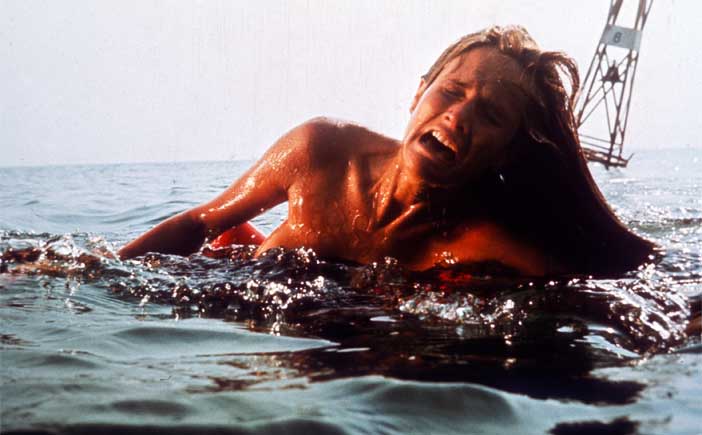
A Shark in the Edit Suite: Jaws (1975) for TFE's 'Oscar Horrors' Series

Just in time for Hallowe'en, here's a piece I wrote on Verna Fields' award-winning editing on Jaws for The Film Experience's 'Oscar Horrors' series.


Spielberg made it a star of fearful proportions. John Williams gave it an iconic theme tune. Roy Scheider, Richard Dreyfuss and Robert Shaw obsessively stalked it. And Richard D. Zanuck and David Brown looked on, clutching the purse strings, as they all went about their blockbusting business. But the person who gave Amity Island’s Great White unwanted visitor fierce presence and a sinister personality most could arguably be the editor Verna Fields. Alongside Spielberg and Co. she was instrumental in terrorizing the world with Jaws, summer 1975’s maiden blockbuster movie. She manoeuvred the shark’s arrival and departure – in tandem, of course, with Williams’ score – helping to create cinema’s scariest PG-rated, non-human villain...

Read the rest here

22 October 2012

LFF 2012: Lore (Cate Shortland/2012)

A last London Film Festival report. Here's a conversation with David from Victim of the Time on another LFF film. This one is on Cate Shortland's follow up to her 2004 debut Somersault, Lore.

David: A story about the children of Nazis struggling across a Germany occupied by Allied forces is several thousand miles away from what you’d imagine director Cate Shortland’s wheelhouse is. But Lore’s focus on the burgeoning sexuality and voyage to adulthood of a teenage girl is strikingly similar to Shortland’s debut Somersault - so much so that lead actress Saskia Rosendahl often reminded me of Abbie Cornish in her often abrupt movement and slightly displaced screen presence. That might be how I’d describe Lore itself - it never feels truly present or powerful. Instead it filters the story through meaningful objects and eerie poetic interludes, and while this is a method of storytelling I’m certainly not averse to, it didn’t work for me in this case...

 Read the rest here

14 October 2012

LFF 2012: Antiviral (Brandon Cronenberg/2012)

More London Film Festival reports. Here's a conversation I had with David (from Victim of the Time film blog) on Brandon Cronenberg's striking debut feature Antiviral, showing this week at the LFF.

Craig: It’s all about celebrity skin in Antiviral as characters indulge in, ahem, the pleasures of the flesh in one form or another. This being the first feature from David Cronenberg’s son Brandon, I perhaps expected a plentiful supply of gratuitous bodily harm. Having no idea prior to seeing the film just what it was about – all I knew was that it was partially set in a mysterious clinic for the stars – the film came as a minor revelation: not only because, for a debut feature, the filmmaking was of an uncommonly high calibre, but also because the most interesting Cronenberg film this year wasn’t brought to us by the oldest member of the clan...

Read the rest here

13 October 2012

LFF 2012 Review: Black Rock (Kate Aselton/2012)

Head over to The Film Experience for another review from the 56th BFI London Film Festival: Kate Aselton's survival drama Black Rock.

Lake Bell, Kate Aselton and Kate Bosworth in Black Rock

It’s certainly a bad day at Black Rock for Kate Bosworth and her two BFFs. Director/co-star Kate Aselton and Lake Bell both cherish Bosworth’s friendship  but they have their own shaky history festering between them like an open sore. The three women go for a ‘last hurrah’ camping trip to the titular retreat with treasure hunts and restorative bonding in mind. That’s until they chance upon a trio of ex-soldiers, not long back from Helmand Province, on a suspicious shooting trip...

Read the rest here

LFF 2012 Review: Blood (Nick Murphy/2012)

Head over to The Film Experience for my review of Nick Murphy's new police drama Blood, showing at the 56th BFI London Film Festival.

Paul Bettany in Blood

Nick Murphy’s Blood (showing in the festival’s "Thrill" strand) explores the secret cost of human damage on a small group of people in a north of England town. Bodies are invaded and battered; the red stuff is in plentiful supply. Cops, criminals and their families all reach the end of the tethers in this stern, cold police drama about the murder of a teenage girl and its aftermath. Police detective brothers played by Paul Bettany and Stephen Graham investigate the crime...

Read the rest here

16 September 2012

Take Three: Series 3 Wrap-up @ TFE

Over at The Film Experience I've written up a quick wrap-up entry for the third and final run of my ‘Take Three’ column, the weekly series that looked at three notable performances from a supporting or character actor's career. (Click on the actors’ names for their respective Takes.)

It’s perhaps fitting that last week’s Take Three featured Brad Dourif as, when the idea for the series was first mooted, Dourif was the first actor who entered my mind. It’s odd perhaps that I left him so long, but I’m glad he was included in the end. I was also glad to include a quintet of actors – bigger names, well versed in veering between lead and character actor roles – who have vast and interesting careers under their belts: Christopher Walken (one of Seven Psychopaths due in cinemas soon), John Hurt, Tommy Lee Jones (currently sexing it up with Streep in Hope Springs), Danny DeVito and Chris Cooper. Series 3 started off with one of today’s best, Melissa Leo (receiving acclaim this week for her role as Francine); she was closely followed by another, Anne Heche...

Read the rest here

11 September 2012

Take Three @ TFE: Brad Dourif

This week my "Take Three" column (every Sunday, three write-ups on three performances in a supporting/character actor's career) over at The Film Experience features Brad Dourif in a variety of roles including Wise Blood, One Flew Over the Cuckoo's Nest and the Child's Play films.

*Note this is the final Take Three in this third series (apart from a S3 wrap-up entry next week). For now, it's done. But perhaps maybe one day I'll resurrect it... maybe even in a different form*

Take One: Dourif & Auteurs

The sign of a great character actor can often be seen in the directors they work with. Of course not all will be universally lauded names (character actors don’t get to pick and choose like A-list stars), but when they repeatedly work with filmmakers of high regard you know there’s something special about them. Dourif has worked with some of the most visionary and celebrated directors working. The likes of Werner Herzog and David Lynch, whose off-kilter approach perfectly chimes with Dourif’s, have cast him time and again...

Read the rest here

5 September 2012

Take Three @ TFE: Samantha Morton

This week my "Take Three" column (every Sunday, three write-ups on three performances in a supporting/character actor's career) over at The Film Experience features Samantha Morton in Under the Skin, Control and The Messenger.


Take One: Under the Skin (1997) After some acclaimed TV and short film work, Morton made her feature bow in Carine Adler’s Under the Skin. In it she plays Iris, a girl selfdestructing and suffering due to the death of her mother. In this blistering debut Morton flits between girlish abandon and hot-tempered wilfulness. At times the camera has trouble keeping up with her as she weaves through life picking up numerous sexual conquests in retaliation for not being able to confront her grief. Other times, the camera can’t seem to pull away from its close focus on Morton’s expressive face, as in the scene where she enters a church and tearfully gazes at the congregation...

Read the rest here

31 August 2012

Take Three @ TFE: Christopher Walken

This week my "Take Three" column (every Sunday, three write-ups on three performances in a supporting/character actor's career) over at The Film Experience features Christopher Walken in True Romance, The Prophecy and The Deer Hunter.


Take One: True Romance (1993) One of Tony Scott’s best loved films was True Romance, based on Quentin Tarantino’s script. And one of its most fondly remembered supporting performances was Walken’s psychotic criminal Vincenzo Coccotti. His sole scene – the ‘Sicilian scene’ as it became dubbed – is often quoted for its spiky dialogue and playful yet intense interaction. In the scene Walken pays a visit to Clifford Worley (Dennis Hopper) for information on the whereabouts of the latter’s son Clarence (Christian Slater). Worley knows that he’s going to die regardless of what he tells Coccotti, so he relates an offending story hoping to insult him as a last FU. For the most part Walken does seemingly very little; Hopper does most of the talking. But his responses, his turning to his henchmen for reactions and hardy yuck-yuck laugh add an amusingly unsettling tension...

Read the rest here

22 August 2012

Take Three @ TFE: Rosanna Arquette

This week my "Take Three" column (every Sunday, three write-ups on three performances in a supporting/character actor's career) over at The Film Experience features Rosanna Arquette in Desperately Seeking Susan, After Hours and The Divide.

Takes One & Two: Desperately Seeking Susan and After Hours (both 1985) Rosanna Arquette was very much at home in Eighties New York. As Roberta Glass in Susan Seidelman’s Desperately Seeking Susan and Marcy Franklin in Martin Scorsese’s After Hours, she had some strange and bewildering night-time adventures. Her well-to-do New Jersey housewife in the former sought and stalked an elusive Madonna; in the latter she was a curious, oddball girl courted by a desperate Griffin Dunne. These two films were early high points in Arquette’s career and established her as one of the decade's most likeable character actresses.

Read the rest here

14 August 2012

Take Three @ TFE: Tommy Lee Jones

This week my "Take Three" column (every Sunday, three write-ups on three performances in a supporting/character actor's career) over at The Film Experience features Tommy Lee Jones in No Country for Old Men, Jackson County Jail and The Hunted.


Take One: No Country for Old Men (2007) In Joel & Ethan Coen's No Country for Old Men the ostensible main character is weary Texas lawman Sheriff Ed Tom Bell played by Tommy Lee Jones, though his co-star Josh Brolin is the film's nominal hero. Jones, though, an ‘old man’ on the verge of retirement and tired of the country he’s patrolled for so long, brings a melancholic meaning to the film’s title. Bell had more of a life/backstory in McCarthy’s novel (much of which the Coens left out) wherein he discusses his experiences in WWII, which hint at a desire to shy away from violent combat/confrontation; his life is generally laid out in more detail. What we do learn of Bell in the film is from the slivers of significant information Jones imparts in his refined characterisation...

Read the rest here

6 August 2012

Take Three @ TFE: Barbara Steele

This week my "Take Three" column (every Sunday, three write-ups on three performances in a supporting/character actor's career) over at The Film Experience features Barbara Steele in Black Sunday, Curse of the Crimson Altar and Shivers.


Take One: Black Sunday (1960) In Mario Bava’s Black Sunday (also known as  La maschera del demonio or The Mask of Satan) Steele plays Princess Asa Vajda, a woman put to death by her brother in Moldavia, 1630 only to be resurrected 200 years later as a vampire-witch. Steele also has a second, key role, as local woman Katia Vajda. Princess Asa’s eager to wreak the long-promised revenge upon her descendants – thus proving Sunday is far from a day of rest for the undead. Black Sunday, highly influential and memorable to future horror like Bloody Pit of Horror, Bram Stoker’s Dracula and Sleepy Hollow, features some of Steele’s best work.

Read the rest here

4 August 2012

A few words on film lists and the S&S ten-year poll

The other day The Film Experience's Nathaniel Rogers asked all contributors for some thoughts on the recent Sight & Sound ten-year poll. Below is what I came up with:

Above: the cycling scene from Yasujirô Ozu's Late Spring/Banshun (1949), 
which came out at #15 on the poll and a dead cert for one of my personal best/favourite films of all time.


I never see the harm in assembling lists of films to try and assess what does or doesn’t define tastes. If anything, it’s an ideal prompt to get people talking about films, something I’m sure we’re all always pleased to see happen, and a great way to weigh up viewing habits. The Sight & Sound ten-year poll is a ‘big gun’ in this area of film appreciation. I look forward to it and enjoy mulling over the films selected. (I especially like scanning the individual contributor’s choices as they invariably contain wider diversity, some surprises, a few shocks.) But, as with any vast list-making exercise, it shouldn’t necessarily be seen as gospel. The idea of a Greatest List of All-Time Best Films is a tricky and complex one. The word ‘greatest’ has the ring of impenetrable stature, all too rock solid and time-tested. Maybe it should be: What 10, or 30, or, say, 147 films hit you in the gut the hardest, ripped your heart out (this opens up much creative licence to include, say, overly sentimental weepies or cheap, quickie zombie flicks – films which very rarely, if ever, make any list of ‘best’ but indeed have their place), or even caused you to never see the world the same way again. But, ultimately, it’s all technically the same thing: what are the films that we have collectively or individually connected with on a strong emotional level. There’s no truly definitive answer, so the S&S list is what it is: a solid and fascinating collation of celluloid milestones and pleasures that acts as some kind of cultural barometer as well as a to-(re)watch list for casual moviegoers and cineliterates alike. But, whether you’re pro or con on the practice of ranking films, it does at least inspire some passionate, hearty debate, which is essentially the whole point.

30 July 2012

Take Three @ TFE: Danny DeVito

This week my "Take Three" column (every Sunday, three write-ups on three performances in a supporting/character actor's career) over at The Film Experience features Danny DeVito in Ruthless People, The War of the Roses and Batman Returns.


Take One: Ruthless People (1987) DeVito wants Bette Midler dead and gone in Ruthless People. The sooner the better preferably, with a minimum of fuss and personal expense. Sam "spandex mini-skirt king" Stone's wife Barbara (Midler) is kidnapped by the nicest people to ever venture to the criminal side, Judge Reinhold and Helen Slater. When, over the phone, Reinhold relays his strict rules regarding heiress Barbara's ransom, DeVito’s face brightens by the minute at the idea that she will be killed if he disobeys their orders or if any police intervention is suspected. Cue a fleet of cop cars and every news channel in LA reporting on the story. Cut to: Sam popping a champagne cork with filthy glee...

Read the rest here

23 July 2012

Take Three @ TFE: Eva Mendes

This week my "Take Three" column (every Sunday, three write-ups on three performances in a supporting/character actor's career) over at The Film Experience features Eva Mendes in Live!, Hitch and Last Night.


Take One: Live! (2007)
Building on her dramatic work in We Own the Night the same year, Mendes took on another (semi) serious role, one deviously tinged with delicious black comedy, as TV executive Katy in Bill Guttentag’s Reality TV mock-doc Live! Perfectly styled in sharp attire and a coffee ‘to-go’ in hand, Mendes' Katy is ambitious, ruthless and most likely hollow on the inside. She has grand ideas. One of them kick-starts Live!’s plot: six members of the public will play Russian roulette live on air; the sole survivor is the winner...
Read the rest here