22 August 2010

At the Cinema: The Killer Inside Me

The Killer Inside Me (Michael Winterbottom/2009) USA/109 mins *****


The hubbub surrounding The Killer Inside Me was to be expected - and to be duly taken with a hefty dose of deliberation. Although, in effect, the uproar over the film is part and parcel of its interest. A film like this shouldn't slip by unnoticed - and in today's net-savvy world a film like this never could. Films that portray brutal violence on screen should sear a visible mark on our screens and leave a socially-dubious skid mark on our brains.

Michael Winterbottom’s adaptation of one of Jim Thompson’s darker, clammier novels follows small-town sheriff Lou Ford (Casey Affleck) as he weasels around 1950s dead-end Texas. He divides time between uber-violently mishandling both his girlfriend Amy Stanton (Kate Hudson) and hooker-mistress Joyce Lakeland (Jessica Alba), and mismanaging various shady comings-and-goings with other local authority figures; all the time becoming more and more haunted - via some handy flashbacks - by a traumatic event from his boyhood.

Thoughtful attention from various external sources (audience and festival reactions, press coverage, film-industry responses etc) assists in bringing a film to our attention and help to find it a bigger audience. But it's dividing the intelligent or worthwhile responses (looking at a film with good measure, placing it in a wider cinematic or social context) from the alarmist or knee-jerk responses (Oh-my-god-this-film-is-sick! - I therefore shall never see it!) that’s the tricky part of the equation.


The more level-thinking, reasonable adults who see this latest succès de scandale, the better. The debate around cinematic violence can then widen to take in fresh voices - some of them will undoubtedly be crucial, constructive and, hopefully, progressive. (Though of course some will certainly be Daily Mail ‘up-in-arms’ reactions over it all). The Killer Inside Me's frequent violent scenes are questionable, troubling and horrible; it’s compulsive, often difficult viewing. It is, to be blunt, just as it should be.

The extended scenes of brutality - most often aimed at the two women in the protagonist's life - don't leave much space for drawing clear breath over their arduous durations; they're queasily prolonged, upsetting and the kind of scene no-one really likes to have to think about, let alone watch, over many agonising minutes of screen time. (Several minutes last much longer than we often assume in the cinema).


Much of the film’s tone is ungraspable and strives to be putrid. One reading of the film could suggest that it all occurs within Lou Ford’s warped psyche; all - or at least most - crucial events could be filtered through his unreliable perspective, skewed as such by his psychotic fallibility. Another reading could infer that it's simply the way Winterbottom lays it out, that he’s simply umpiring a clever game of Shock the Audience. Either idea points to why the film is both intriguing and infuriating in (roughly) equal measure.

That tone wavers plenty, but there's perhaps no distinct purpose to much of the film. But then violence itself never really has a distinct purpose - it just happens. Those that inflict it may have their own reasons, however misguided or ill judged, but those who feel it see no justifiable reason. But by the end I was left only with a hazy impression of a sickened mind, nothing concretely compelling or solidly conveyed.


On more than one occasion I pondered the notion that it was notorious genre-hopper Winterbottom’s “go” at Film Noir: guns and girls go with the territory, and Thompson’s the go-to guy for questionable violence; mix the two together and - voilà! - an instant polemic for our consideration. (Thinking back to how rounded other less flashy, more naturalistic explorations of murderous men like, say, Vengeance Is Mine or Henry: Portrait of a Serial Killer were, The Killer Inside Me feels like too much stylistic posing, without interest in truly mining the ickiest recesses of a blackened mind.)

There's not much middle ground. What there is of it is narratively shaky, unstable; away from the shock scenes or moments of limpid exposition, very little happens that nudges things forward. Winterbottom’s attention to detail, and how he propels the plot along in the scenes not impregnated by the imminent possibility of eroticised menace, isn’t perhaps as assured as it is within the ones that are. But he is savvy enough to position his beacon scenes of high violence few and far between, therefore maximising their potential shock impact on the audience; we get due time to stew in our afterthoughts.

There’s scant interest in the character’s lives. How they practically and emotionally exist outside of Winterbottom’s need to see them either inflict pain, or react to it being inflicted, is largely absent. Merely positing that the violence is justified because it’s aroused via the sickest perspective in the room (as he has suggested in interviews), and therefore unable to be disentangled from his main character's particular viewpoint, sounds as if he’s setting a blaze and then leaping for the fire escape.


The reasoning (and explanation?) for all the murky visualisations of violence may reside somewhere between Ford’s and Winterbottom's gazes; character or interpreter, there’s a curious chasm for eisegesis between the two. I wasn't entirely sure whether the narrative's elusive tone was a clever device to nudge for critical responses or simply a whole lot of smoke to cover the fact that no one here may have had a concrete perspective.

Either way, it's the most intriguing stab at opening up the onscreen debate on film violence for at least a few years - and it’s one hornet’s nest that the media and the cinema-going public alike should have hit on a bit harder. (I seem to remember a bigger kerfuffle on the 2000 re-release of Kubrick’s A Clockwork Orange; I was hoping for multiferous levels of Crash-like controversy.) For a polemic to really dig its nails into society, you want it front and centre, on everyone’s lips. The splash Killer has so far made hasn’t been as sizeable as it should have been. Whether it’s due to Winterbottom’s indetermination or a lack of interest in the problem it poses, it’s a film that at least invites us to ask hard questions.


On the acting side of things, Affleck was good - all lazy-eyed ugliness and contemptuous line delivery, as if he viewed everyone he met as scarcely worth wasting more than the bare essential of words on - but it’s very much an extension of his Robert Ford character from The Assassination of Jesse James... (In the world of fictive movie connectivity they might even be distantly related.) Alba and Hudson’s previously untapped willingness to branch out (both are more widely known for lighter rom-com fluff) means we get commendably intense work from them; both give generous performances for little in return. Although only Hudson is the right fit for ‘50s small-town noir.

The muggy atmosphere and lushly-detailed period trappings are a visual treat nonetheless. (DoP Marcel Zyskind lights the dank interiors and the wide-open landscapes with the same sweaty zeal; the grab bag of songs are cues of the creepiest kind.) But for my money The Grifters is still the best Jim Thompson adaptation, with a nod toward Maggie Greenwald's underrated The Kill-Off and Thompson's own dialogue work on The Killing.

20 August 2010

At the Cinema: Salt

Salt (Phillip Noyce/2010) USA/100 mins. *****


Angelina Jolie performs wonders with a very liberal sprinkling of kick-ass in Salt. In scene after scene it's all she does. Not that I'm complaining - the very idea of Jolie plowing through a city armed only with a How to Kick Ass & Do It Right manual and a gnarly pout was what lured me in. For well over a decade she's been trooping through a glut of action roles - two Lara Crofts, Gone in 60 Seconds, Mr. & Mrs. Smith, Wanted - making short work of dispatching anyone who got in her way. Here, as CIA agent Evelyn Salt, she ramps up the damage up a notch or ten. If I were a henchman given orders to halt Salt, I'd sooner ask for my P45 than attempt to bring her down. So, you wanna blast your way through this office to freedom huh, Ange? Don't let me stop you - there's the door, kick it down and be on your merry way.

After a prologue and some very brief opening titles (who needs either to be long?) she's about to clock off for the day when a Russian defector wanders into her workplace with Soviet secrets to spill. Together with boss Liev Schreiber and counter-ntelligence head Chiwetel Ejiofor, she interrogates him only to find out that he's named her as a Russian sleeper agent set to - good gosh - destroy America by killing its top brass, including the president himself. Alarmed, and like a one-woman A-Team, she makes inventive use of all available wares - a table leg and fire extinguisher suffice nicely - to explode her way free. Then off she trots, with everyone in obligatory hot pursuit. Is she a secret spy? Is she innocent? Does it matter as long as she lays waste to anything and everything in the quest to prove or disprove either fact? Kevin Costner could find No Way Out back in '87 - he should have just stayed put and waited for Jolie to find it for him.

Furniture's not for sitting on, it's for constructing makeshift weaponry, says Salt

It's all very preposterous and incredibly daft. Is this a problem? Is it heck! There are implausibilities and plot holes bigger than her infamous lips, but if you're wasting time trying to spot them you're not watching what really matters: how many times, and how inventively, Jolie issues her smackdowns. She leaps from a trio of trucks during a high-speed chase, slides down a lift shaft (Jolie hasn't got time to press buttons!), and smashes her way out of no less than three buildings; she doesn't bring the roof down - that's been done before - she brings a floor down: that's how hard she is. I suspect she only runs up walls to gain a better vantage point to kick people in the face. The only time she walks anywhere is when director Phillip Noyce chooses to film in slow motion: gliding through the lower deck of a ship Jolie tosses out hand grenades as if she's casually spreading lawn seed - and to a thudding score last heard accompanying liquid Robert Patrick in Terminator 2.

Brunettes have more fun: which side is Jolie gunning for as Salt?

Noyce and cinematographer Robert Elswitt work well together to spotlight Jolie's striking visage. They know what their big draw is - their camera clearly loves her face. (She's given numerous close-ups when she needs to emote purposefully.) Indeed, she's very good at conveying the many moments of internal conflict required. Her character needs to keep us guessing as to who she really is, and Jolie duly retains a poker face throughout; it counteracts the occasional narrative or directorial slip up that - possibly unintentionally - reveals more than it at times needs to. There's also a dafter-than-daft scene where Jolie has to dress as a man (she's infiltrating!), which makes her look like a slightly-melted Tom Cruise waxwork - possibly a sly nod to him turning the role down when he was Edwin rather than Evelyn. Thank gladness he did - we don't need to see him running from Government Types and/or anyone and everyone so soon after last week's Knight & Day. And anyway, this feels entirely right as Ange's adventure.

I'm glad that Jolie's intermittent striking out as an action heroine still yields enjoyable results (Wanted aside). It's often far more refreshing to see a woman cut a dash on the action. I'm sure they'll be further Salty outings. Jason Bourne got sequels. Bond's mastered plenty of missions, and has been recently re-booted. The A-Team were dug up and dusted off a few weeks ago. Let's hope Jolie, Noyce and co. pass us the Salt a few more times. It's immense fun whilst it lasts.

19 August 2010

Can you articulate what you always search for in movies?

A question asked by Nathaniel R at The Film Experience.

It's a tricky question to properly and definitively grasp, let alone properly and definitively answer. But, without sounding like I'm sheepishly dodging the question (which, really, I guess I am), or attempting to be precious about it (which, really, I'm not), it's simply movies themselves. Everything they offer - everything they do and mean, all at the same time. Whatever that is. And of course it's personal: we're all searching for something that connects us to the pictures we see on screen.

It's unmissable movies. It's great movies. Good and merely OK movies. On occasion even terrible movies can have one or two moments of sheer brilliance in them. But it's just moving pictures themselves, projected in an evocative order - not necessarily A-Z - and played out for me in whatever sublime or messy form they choose to take (any genre, long, short, glorious colour, black & white, and so on - any and every which way they come). It's everything contained in the ongoing pleasure that each one might allow. Ongoing pleasure: key words, both.

But, in all honesty, it's something I don't really want to answer. If I knew what it was that I search for in movies, and how to articulate it fully, I may not watch any more. I'd have found the reason for doing something I cherish and have no need to continue to find out. And as far as I know, that ain't gonna happen any time soon. Gladly, the search will just have to continue.

So, see, I can't possibly come up with a good enough proper answer. And I'm thankful not to really be able to. The above cop-out points to this rather wholeheartedly. But, to try and be a good sport, and because such a question is worth a stab for any committed movie lover, here are the first five things that came to mind when I stopped trying to think of an answer (which, for now, will do me fine):

1. Mood mood mood
2. The thrill of images
3. A team of talented, exploratory folk who know their way around a camera
4. The given film's ability to grab the heart first, then the brain.
5. Zombies. Lots of them. (Grabbing at my heart and my brain!)

And, yes yes, of course all those wonderfully worthy, always-sought-after and meaningful things like art, truth, creative endeavour, memorable characters and the like. Throw those things in there, too.

But mainly it's the thrilling images and the zombies.

14 August 2010

Review: Permanent Vacation (Jim Jarmusch/1980)


Jim Jarmusch's debut feature Permanent Vacation, filmed in 16mm directly after he dropped out of film school, opens in eerie, memorable fashion: empty New York side streets, strewn with various oddments - wind-blown detritus, waving tramps, discarded products of life - are intercut with slow motion pedestrians (with normal-speed sound) walking busier mainstream streets. An ominous hum plays over these images - backed with discordant chimes and floating saxophone - offering the feel of a lost city, a nowhere zone, as if we're perhaps seeing The Big Apple's mouldy core just after some non-specific apocalyptic disaster. It's a transfixing start to Jarmusch's movie world. Then we settle into (what was to be) familiar Jarmusch territory. His first drifting, anti-leading man, Aloysius "Allie" Parker (Chris Parker), wanders the city fruitlessly, graffitiing slogans on walls, meeting various strangers - most of them savage innocents who are seemingly madder than a bag of cats (Richard Boes as a paranoid war vet, Frankie Faison laughing alone in a cinema lobby, John Lurie as the sax player, María Duval as a wailing Latin waif) - and pondering both the meaning and the meaninglessness of life: the two can often be read as the same with thing Jarmusch.


Much like his follow-up film, 1984's Stranger Than Paradise, and many more since this debut - particularly Night on Earth, Broken Flowers and his latest film, The Limits of Control - Jarmusch's primary interest is in the not-doing of things, the little nothing moments in life, and the characters - all stranger-than-strange like-minded souls - that pop up at intermittent junctures to spout often nondescript observations on life and/or culture. For me, it worked best in Down by Law, Dead Man and Mystery Train. Here, though, little of interest is said (Parker's opening and closing monologues are strained with vacant, though apt, pretension). But of course the journey to nowhere - any journey, anywhere vague - is what interests Jarmusch most. The film's title could just as well have been Permanent Stasis, so committed as he is (and was from the start) in repeating ideas and unvarying his chief thematic concerns.

Would his hardcore fans want it any other way? That's what he does, it's who he is: has there ever been a director so inextricable from his film work? The opening five-or-so minutes here are some of the most resonant and disquieting images he's put on screen - and I could see some of that strangeness infiltrate, still, the Spanish street imagery in Control. But after Vacation's 75-minute running time (though it feels longer) of aimless soul-searching, Parker seems none-the-wiser as to what he was after. But then, life-challenging realisations aren't what this drifting hipster is seeking. So to bemoan the film for its inaction may be to miss its point. Although, without much of interest doled out during its middle section I found it hard to care either way. But then the closing images, like the film's unworldly beginning, are another highlight: this time a long take of Manhattan Island, again accompanied by the weirdly beautiful sax-and-chimes score, seen from a departing ferry. We vacate from New York but Jarmusch's film remains motionlessness.

6 August 2010

Review: Life During Wartime (Todd Solondz/2009)

With Life During Wartime I've realised that Todd Solondz has become tiresomely near-irrelevant as a filmmaker. It's a joyless, visually ugly and entirely wearing film. It's full of arch dialogue, with no discernible point, that says little about the characters (the same bunch of socially-ill-adjusted blanks that he gave us in his 1998 film Happiness; to which Wartime is a kind of sequel) and more about how resolutely mischievous Solondz still desperately wants his audience to see him. (Read the plot outlines of both films here and here - it's convoluted task and would needlessly pad out the word count here.) The film goes nowhere interesting. It's largely made up of too many forcibly ironic conversations - all too often filmed in dry, uninspired two-shots - that go only part way in illustrating Solondz's not actually all that interesting overriding theme of the forgetting of past deeds and the idea of forgiveness attached to them.

Joyless: Ally Sheedy and Shirley Henderson respond in kind to a 
ghostly intervention from Pee Wee Herman in Life During Wartime

All but, I think, two characters in the film cry in various states of self-dissatisfaction, often with no overtly explicable reason to do so. (And they cry unconvincingly at that: whether the characters' crocodile tears were intentionally faux affectations, or whether the actors involved couldn't quite muster up the requisite sadness is a mystery.) Sure, their lives are pained, but, without someone having seen Happiness beforehand (and Solondz has to suppose that some audiences haven't), or due of the self-consciousness of the stilted, pretentious dialogue, it could be read as just a load of miserable fucks spouting ponderous nothings, all after an effect; and through this the thematic thread about forgiving and forgetting is all but lost.  

They launch into these teary hissy fits because Solondz prescribes that his characters must appear ironically traumatised at all times, and having them constantly wallow in their self-made woe is his desired way to emphasise this. He doesn't give them anything else to do. They're merely mouthpieces for his half-baked agenda. I didn't see any reason to actually care about them - nor why he felt compelled to bring them back from Happiness. But in taking further the tricksy casting in Palindromes, he reassigns new actors to play the same characters from the earlier film, perhaps because it was a way to inject some freshness to the retread. Or was it because the original actors too saw no reason to further the story? Whatever it was, everything points south to the redundancy of the concept.

Lifeless During Teatime: Allison Janney and Michael Lerner 
wonder quite who they're supposed to be playing

Charlotte Rampling's (as a barroom floozy) and Ally Sheedy's (as Helen, Lara Flynn Boyle in Happiness, now a flaky Hollywood screenwriter) scenes are entirely superfluous; nothing happens that's either funny, interesting or narratively relevant when they're on screen. Rampling, thanks to the awful photography, just looks like a melted Grim Reaper with terrible hair extensions; and Sheedy is given somnambulant dialogue, full of dated references, to drawl, but is disallowed any facial movement, or so it seemed. (She mentions her lover "Keanu" - Keanu? Topical digs at the much-maligned actor feel very early '90s to me.) The rest of the cast - save for Michael Lerner and Allison Janney as a lovestruck, but appropriately troubled, couple - are largely forgettable. Oh, but Solondz has Pee Wee Herman himself (Paul Reubens) pop up as a ghost: once in a restaurant, seemingly just to say the word 'cunt', as if him saying it is the holy grail of shock; and again... in a room full of Emmys - because, you know, it's like a critique of awarding bodies. Or Something. Solondz's satire has never felt so weak.

I've read various folk both online and in print (and spotted various poster quotes) mention the "dark, but hilarious comedy" of the film. But that's only true if comedy were a needle and the characters' neuroticism were the haystack. It's not worth poking around for laughs, dark or otherwise - there aren't any. Solondz only really has one story in him, and he's told it two or three times already. With Wartime he's proved that he has nothing much, or nothing new at least, left to say.

4 August 2010

Three Takes Only (Pt 2)

At times the post updates on here can be few and far between, but in the interim I'm often busying myself with my Take Three series over at The Film Experience. Here are more handy links, direct to the series posts, for instant perusal.

1 - 4 of the Take Three columns (Veronica Cartwright, Ben Foster, Thelma Ritter and Don Cheadle) are linked to in a post here. And the name links below take you to the other seven (with the three films I discuss) so far :

5. Miranda Richardson
Damage / The Crying Game / Spider

6. Jennifer Coolidge
Legally Blonde / The Bad Lieutenant Port of Call: New Orleans / Best in Show

7. Radha Mitchell
Rogue / The Crazies / Finding Neverland

8. Peter Lorre
Stranger on the Third Floor / Casablanca / M

9. Kerry Washington
Our Song / The Dead Girl / Lakeview Terrace

10. Alan Arkin
Thirteen Conversations About One Thing / Little Miss Sunshine / various films (Arkin remix)

11. Anjelica Huston
Choke / Manhattan Murder Mystery / The Grifters

This Sunday it's Rosamund Pike. And quite likely to get the Take Three treatment soon are:

Grace Jones, Amanda Plummer, Christopher Lloyd, Alfre Woodard, Emily Mortimer, Margaret Dumont, Isaach De Bankolé, Michael Lerner, Jeff Goldblum, Anna Faris, Laurence Fishburne, Ruth Gordon, Dianne Wiest, Peter Sarsgaard, Deborah Kara Unger, Julie Walters, Anthony Mackie and Sterling Hayden. Plus many more lined up for the future.

3 August 2010

Tuesday Title: Lost Highway

Each Tuesday I post a still from the opening titles of a film - as a celebration of great title sequences, cinematic use of typography and the feeling of anticipation in waiting for a film to start...

Today: Lost Highway (David Lynch/1997)


Fade in on a fast POV view of a road at night. Car headlights illuminate the centre lines dividing the two sides of the road - a sly indication, perhaps, of the two distinct (but ultimately intertwined) narrative segments of Lost Highway, and the doubling theme employed - as ever -by David Lynch for his "21st Century horror noir".

The opening titles zoom at the screen in block yellow stencil type. David Bowie's 'I'm Deranged' cuts in: he sings, "Funny how secrets travel." We know Lynch loves his secrets. And of course he loves the open road - as long as it leads us somewhere dark and dreamy, and never, ever comes to an end.  

Lost Highway constantly splits off down warped avenues, to only then converge back to the staring point - though seen from different perspectives a second, third or fourth time. And then seemingly plays again and again - down the same road, but with infinite possibilities for careering off in further new directions.

We see just how secrets have traveled come the end of the film. Time has looped around, veered left and right (but never straight down the middle), and then doubled back on itself several times over. The opening titles become the closing credits: a visual repeat, but with significant and baffling alterations. Lynch's spectacular mindfuck brings back Bowie's song (more ethereal this time) to usher the film into desperate head-morphing oblivion. Lost Highway will always fascinate me - and its titles will always give me a thrilling jolt each time I watch them.

But maybe one of Lynch's naughtiest secrets is the fact that Lost Highway's opening titles are, in fact, very similar to Jack Cardiff's for his 1968 film Girl on a Motorcycle. (You can see the opening titles sequence for Girl on a Motorcycle at the excellent The Art of the Title website - scroll down to the second post, then scroll down slightly further to compare and contrast with Lost Highway's opening titles.) Lynch, you sly ol' dog.

This is the last Tuesday Title for a while. But it is...

1 August 2010

Anjelica Addendum: a few extra notes on Huston and The Grifters

My latest Take Three column over at The Film Experience (where each Sunday I write about three films/performances from a character or supporting actor or actress' career) is the wonderful and always watchable Anjelica Huston. As an addendum, a supplementary addition to the column, I wanted to post up a few tidbits and pictures that I didn't include there; a few things I liked and wanted to make mention of, but that would've made the piece longer than it already is. In my research I came across many fantastic images of Huston that I hadn't seen before and, through looking further into The Grifters (1991) in particular, there were some further thoughts I wanted to share. 

This enticing image below - a publicity shot for The Grifters - captures the right mood and feeling of Huston's character, Lilly Dillon. It perfectly echoes the film's screenwriter Donald E. Westlake's description of Lilly in his second draft (March, 1989) of the film's script: '39 but looking younger, beautiful but cold and watchful'.


The two actions that Lilly is most often seen doing in the film are smoking and making phone calls; she's constantly angling for quick deals - weighing up the odds for a fix - whilst furiously dragging on a cigarette on the go. She's jittery and apprehensive for much of the film; but at other times she switches gear into hard-case-Lilly mode, to aggressively scold someone or exchange 'don't-fuck-with-me' glares with various periphery characters. Lilly's a vulnerable woman, fighting her corner each step of the way. She nervously veers from one encounter to the next in an attempt to get herself out of an assortment of tricky situations. She exhibits a stallion-like composure; underneath it all she could bolt at any minute.


The Grifters' director Stephen Frears often shoots Lilly almost pushed to the edge of the film frame. It's a directorial decision that visually emphasises how she tries to secret herself from the dangerously chaotic world around her. It enhances how she attempts to evade detection and insists on minding her own business - that's when she's not minding the business of others. She's shot like a displaced Edward Hopper subject as seen through cinematographer Oliver Stapleton's inky, noirish camerawork. (Stapleton also brought a similar noir tint to Altman's 1996 film Kansas City.)


I think Frears and Stapleton's perceptive, implied nod toward Hopper's more famous, and much cinematically referenced, paintings is far subtler, intrinsic and deftly utilised than many of the directors who have taken influence from him, especially in the case of, say, Wim Wenders' self-conscious mimic of Hopper's 1942 painting 'Nighthawks' in his film The End of Violence (1997), below. Wenders is commenting on the Hopper painting (note the camera present, the film-within-a-film angle), but his blatant evocation of it loses something in the process; by directly referencing Hopper's work the nod is then just a straight-up acknowledgement of influence. He's merely idly creating parody, instead of tantalisingly arousing the feel of the painting, or what it might mean, into the film's world - which is what Frears and Stapleton achieve in The Grifters.


They understand that a retro- or neo-noir film has to set up and inhabit its own world fully, and that an homage only adds to, and doesn't define, the overall effectiveness of a given shot in their film. In the scene in The Grifters above (when Lilly, drinking coffee and taking time out from the grift, is rudely interrupted by, and has an altercation with, a pushy tramp) Hopper's sensibility is present and is as discernible as it is easily recallable. But his influence doesn't overcome either the visual composition or the ideas and feelings that Frears wants to impart or arouse in the audience.


The image above, of Lilly sitting on a hotel bed putting on make-up as she casually glances at a TV screen, readying herself for a particularly crucial encounter, again refers to both Hopper (albeit less so than in the diner scene) and elements of classic Film Noir. But isn't necessarily defined by, or in too much awe of, either reference. And in one brief shot a lot about who Lilly is is revealed.The loneliness, personal private sloppiness and almost regal posture speak volumes about her inner life.

Another way Lilly is shot throughout the film - again it's a particular but often overused directorial attribute in framing shots, though, in my view, not by Frears in The Grifters - is through visual barriers: whether it's with the horizontal lines of venetian blinds (when Lilly visits her son Roy in hospital, below top) or the concertina grid of an elevator shutter (in the film's penultimate shot, below bottom). Such visual divisions, positioned between the character and the viewer, often tend to depict a character as held within their own personal prisons, or perhaps trapped in situations somewhat of their own making.

This idea is somewhat applicable to Lilly, but, more than overstating the commonplace use of these barriers, Frears and Stapleton - and, of course, Huston - show how Lilly is actually forever an outsider looking in (as much as she's an insider on the look out), a woman kept distant from those around her. She's less in a trap than sealed off behind visual obstructions, especially in relation to her son, Roy. Lilly is of the harsh and bruised world of Jim Thompson's The Grifters, but she is also a secluded mother and always at a remove from what she ultimately wants. The allusion to Lilly's interior self is expressed beautifully by Huston in the eternally capricious way she looks at others on screen.


But one of Frears' best allusions/shot references (in regard to that penultimate image of Huston in the elevator, above) is to an image of Mary Astor as femme fatale Brigid O'Shaughnessy in John Huston's The Maltese Falcon (1941). (Note: also in the piece at The Film Experience I make mention of how Frear's depiction of Lilly reaches back through nearly 40 years of noir filmmaking to somewhat chime with Gloria Grahame's character Debby Marsh in Fritz Lang's 1953 noir, The Big Heat.) Of course John Huston was Anjelica's father, and this choice and pertinent noir reference is perhaps the best in The Grifters. There's a plethora of rich and varied pulp-noir lineage nicely contained in Frear's film. One reason of many why it endures as a splendid example of '90s retro-Noir.


Now just for the hell of it, and because the images are some of the best I've seen of Huston, here are some amazing photographs from early on in her career, when she was a model:


27 July 2010

Tuesday Title: The Tomb of Ligeia

Each Tuesday I post a still from the opening titles of a film - as a celebration of great title sequences, cinematic use of typography and the feeling of anticipation in waiting for a film to start...

Today: The Tomb of Ligeia (Roger Corman/1964)


The film's opening is great: Vincent Price - as the fantastically named Verden Fell (who joins Pat Hingle's Bobo Justus in The Grifters and John Hurt's Jellon Lamb in The Proposition as one of the best movie character names ever) - is standing firm over his late wife's coffin, certain of foul circumstance; said late wife's (duel-role-playing Elizabeth Shepherd, as second of these two ladies: the Lady Rowena Trevanion and the Lady Ligeia herself) eyes open, startled by a cat on her tombstone - Price explains it away as a nervous post-death twitch. She's eventually buried, and the opening titles (designed by Peter Howitt and Francis Bodker) appear over some very nice, Gothic illustrations - which look like something Francis Bacon might have dreamt up had he been a commercial illustrator.

The film is based on Edgar Allen Poe's short story 'Ligeia' and, true to his auteur status and reverence among horror filmmakers, it's his name that claims position above the title in Roger Corman's 1964 film. But Corman's unexpected and brooding use of landscape (notably his insistence on using found locations: Castle Acre Priory, Norfolk - not a million miles from me), particularly in the film's pre-opening credit sequence, is just as (visually) evocative as the discernible doses of Poe's macabre wit within the film's script, adapted by Robert Towne.

The opening is a suitably creepy and eloquent introduction to Ligeia - both the film and the wraith-like presence of Fell's almost ever-living wife. And that pesky black cat perched ominously on the tombstone proves more fateful than we first assume. (I was surprised to read that some folk see it as one of Corman's lesser Poe adaptations. I thought it was one of his most interesting and memorable; the inventive framing and expressive use of vibrant colour made the film stand out for me.)

Also worth a mention - Price has one of the best lines in the film, too. Just check out this choice slice of Fell's:

"Christopher, not ten minutes ago I... I tried to kill a stray cat with a cabbage, and all but made love to the Lady Rowena. I succeeded is squashing the cabbage and badly frightening the lady. If only I could lay open my own brain as easily as I did that vegetable, what rot would be freed from its grey leaves."

Wonderful.

The film also has one of the best posters of the sixties, too:

21 July 2010

CFF '06 Reviews: Visit Palestine

Visit Palestine (Katie Barlow/2005)


“Life is ephemeral,” states Caoimhe Butterly, a 24-year-old Irish peace activist, toward the end of Katie Barlow’s emotionally searing documentary VISIT PALESTINE. These three words sound resolutely frank yet hopeful coming from a woman who has spent years tirelessly aiding innocent Jenin civilians under attack from Israeli soldiers. Butterly knows just how temporary human life can be, having witnessed first hand the deaths of innumerable Palestinians (some of whom were her close friends) and by being a victim of the conflict herself; she was shot in the leg whilst leading groups of children to safety.


Death is an everyday occurrence in Jenin. Barlow critically and unflinchingly depicts this with an honest, responsive immediacy. But VISIT PALESTINE’s tone is also wishful; its message one of future hope. Numerous shots show how Butterly’s work has made a direct and integrally positive impact on the families, who see her not only as a friend, but also a saviour. The admiration is mutual, with Butterly being both tenderly loyal and fiercely protective of the people she’s committed to helping. The film sensitively relays deeply saddening testimonies from many victims’ families: one woman talks of her husband’s death with sincere candour - loss etched into her face. Barlow’s camera, like Butterly herself, intently absorbs every word; the moment is quietly devastating. VISIT PALESTINE is an important and much-needed film. It stands as a necessary testament to a singularly courageous person with an unwavering mission to do work that matters; one reason, of many, why the film should be seen.

CFF '06 Reviews: Goblin Wars/The Great Yokai War

Goblin Wars/The Great Yokai War (Yôkai daisensô) Takashi Miike/2005

Take the best parts of The Dark Crystal, splice in some of the more sinister scenes from Labyrinth, then add the surreal vision of Japanese director Takashi Miike and you end up with GOBLIN WARS/THE GREAT YOKAI WAR, his first foray into family-orientated filmmaking. Tadashi (Ryunosuke Kamiki), a boy with an unsettled home life, becomes blessed by a festival dragon to be the Kirin Rider - a mystical title rendering him the chosen one to release a netherworld of goblins from the clutches of a vengeful force, the Yomotsumono, which is intent on creating hell on earth. Like a budding Camelot in Harry Potter clothing, Tadashi goes on a quest with a band of forest-dwelling Yôkai (spirits) to retrieve a sword and bring peace to the world.


Miike’s film is a visual, illusory treat. It uniquely pits gigantic scrap metal CGI robots against a bizarre army of half-human/half-puppet creatures through numerous exciting confrontations in a warped variation of the Good vs Evil story. Dazzling photography - which illuminates apocalyptic reds in the inkiest of night skies - creates a fantastical arena in which childhood adventure is vibrantly turned on its head. It’s a strange, beguiling fairytale, sure to thrill adults and children alike - though it mixes some gory moments in with the comic escapades. GOBLIN WARS shows Miike as adept at youthful adventures as he is with his usual, darker fare. It contains a trace of knowing charm, too, with some cheeky references to both Indiana Jones and samurai films. Its lightness of touch delights even when it scares - especially in the moving and monumental final battle.

CFF '06 Reviews: Safety Last!

Safety Last! (Fred C. Newmeyer, Sam Taylor/1923)

Hurray for Harold Lloyd! Eighty-three years after making it to the top of DeVore’s department store - in one of the most audacious comedy stunts ever filmed - he’s made it to the CFF. The much-loved 1923 silent classic, SAFETY LAST!, is screening in a rare print this year. It was Lloyd’s first full-length feature, made after a decade of shorts, and it’s still an indelible classic of pitch-perfect comic timing. The story is simple: Lloyd, as The Boy from Great Bends, gets a job in the city making big bucks for his new life with his girl. He chances upon a publicity stunt to scale his workplace that could net him an easy $1000 - a cinch for our desperately love struck, hapless hero, surely. But a multitude of unforeseen, and nail-biting, obstacles up the twelve-floor building might almost just prevent him from reaching the top.


Lloyd was an endearing screen presence; his circular black glasses amplifying the innocently expressive eyes behind them - but always letting the audience in on the japery, with a quick wink and a nudge. When he gets into comic scrapes, we slip and slide along with him, not quite knowing where he will land, but each time gasping, then giggling, at the always-witty and inventive outcomes. SAFETY LAST! stands as a testament to his ingenuity as a performer, never better than in the famous, death-defying clock sequence. Lloyd was the grand fool of slapstick, but always an artful and creative one. He inspired instant wonder - all with just a pair of glasses and a smile. 

CFF '06 Reviews: Akeelah and the Bee

Akeelah and the Bee (Doug Atchison/2005)

AKEELAH AND THE BEE follows in a refreshing way the vogue for films that explore the often tense, but rewarding world of the spelling bee. The 2002 documentary Spellbound - along with this year’s Bee Season - set the stage, but Doug Atchison’s new film - receiving its UK premiere at the Festival - rounds out the competition by adding a rose-tinted glow to the trend. Bright 11-year-old Akeelah (Keke Palmer) lives with her single mother (Angela Bassett) in South L.A. and is caught up between hanging out with friends and achieving good grades at school. Gifted with a vast vocabulary, she is persuaded by her principal to enter a local spelling bee under the tutelage of philosophical former spelling champ Dr. Larabee (Laurence Fishburne). After she wins, Akeelah feels the pressure to go national with her linguistic talent, but the path to success is littered with obstacles. 


Revelatory life lessons abound for the characters, and the film has a nicely relaxed feel, helped by the sharply lyrical script. At times events feel drawn from well-used formula and veer close to being uplifting-by-numbers - with many montages of Akeelah selflessly guided by her extended community - but the film is unfettered by its own sentimental charm. The tone is blissfully good-natured, aided by the diffuse, golden-hued cinematography and Palmer’s vibrantly confident performance. The film winds its way into the affections all the same; so confident is the film you can’t help being carried along on Akeelah’s journey. And for what it does - in a simple, heartfelt way - it's almost word perfect.

CCF '06 Reviews: Sympathy for the Devil

Following on from yesterday's slapstick post from the Cambridge Film Festival, here are a few film reviews, jazzed up with a few retrospective edits and tweaks here and there, again for fun and posterity. The aim with these reviews was to be as concise as possible (max. 300 words), to promote the films (i.e. assist in the selling of tickets) and give a flavour of the films in question (hopefully).

Sympathy for the Devil (Jean-Luc Godard/1968)

It’s no surprise that two of the twentieth-century’s most idolised bands both extended their musical proclivities to the silver screen. 1968 saw the Beatles explore tripped-out animation in Yellow Submarine, whilst the Rolling Stones - often considered the artier, grittier band - opted for this documentary essay by Jean-Luc Godard. Godard wanted to work with either band on a film; the Beatles declined, the Stones accepted. SYMPATHY FOR THE DEVIL - a UK premiere screening in a new print - intercuts scenes of the Stones rehearsing the eponymous song with vignettes exploring themes such as race, societal (in)difference, sex and cinema itself. Godard lays out a cultural map and draws allusive comparisons between the nature of performance and political environments, addressed through ideas of revolutionary imbalance that surround progressive artistic creation. Or something to that effect, anyhow.


SYMPATHY is an enticing film for hardcore devotees of Godard or the Stones, but more discerning viewers may feel discontented by the film’s drawn-out, fragmented structure. As the rehearsals proceed, more of the song is tantalisingly revealed, but it’s often abruptly halted for lofty polemical assertions - though perhaps no bad thing with Godard in charge. More than anything, the film’s photography is vibrantly assured; Godard’s camera highlights bloodied streaks on a white robe (flagging it as a beacon of despair) and interwoven scenes of a woman spray-painting political street slogans (Cinemarxism!) are filmed in bleak, misty hues. The Stones’ green and orange-panelled recording studio seems almost homely in comparison - with the Gallic auteur himself handing the Stones cups of tea in the penultimate scene. It’s no Medium Cool, but tepid Godard can still hypnotise.

Addendum: for the record, I personally hated Sympathy - it was one of Godard's most tedious, self-involved and lazy films. But, in accordance with the brief I was set at the time, I had to attempt to be as fair as possible, and help the festival lure in Godard-loving punters and general audiences alike. Maybe some of my dislike showed through, who knows. Note the back-handed use of the word 'hypnotise'. As in 'induce sedation'.

20 July 2010

Tuesday Title: Lifeboat

Each Tuesday I post a still from the opening titles of a film - as a celebration of great title sequences, cinematic use of typography and the feeling of anticipation in waiting for a film to start...

Today: Lifeboat (Alfred Hitchcock/1944)


The opening titles of Hitchcock's Lifeboat aren't exactly remarkable for their use of inventive typography (a rather standard-for its-time title insert), but it was one of Hitch's most memorable opening sequences all the same. As soon as the film started I'd been immediately introduced to one of his best screen characters - with a nod to Steinbeck, who wrote the script at Hitch's insistence - in Tallulah Bankhead's stranded socialite Constance Porter.


It's a smart, effective and very funny opening sequence: after a masterful pan over the downed ship's various flotsam covering the ocean surface (which include a copy of the New Yorker), Hitch's camera rests on a woman in a boat. Surveying the sinking debris of the ship around her - from the relative safety of the small lifeboat of the title - the unblemished, and still impeccably-dressed, Connie lights a cigarette, glances at a ladder in her tights, and tuts, gloriously ignoring the mayhem around her.


When a survivor, Kovacs (John Hodiak), approaches the lifeboat, she grabs her camera and films him struggling to board before just about managing to lend him a perfectly-manicured hand. Capturing a good story comes first for Connie.

Bankhead and Hitchcock ensure that the opening of Lifeboat establishes just the right tone. It's an excellent and endearing film, but also gripping: amid the witty banter and hardy spirit there's some pertinent commentary on the eye-for-an-eye tactics of war that supply sufficient social-political ballast to weigh the lifeboat's passengers down. But it's eyes forward for Constance all the way. Her presence raises the film several leagues to greatness. Wonderful characters deserve wonderful introductions. Bankhead delectably helped keep Lifeboat wondrously floating along.

Sample dialogue: referring to using her fake diamond bracelet as fish bait:  

"I can recommend the bait. I know - I bit on it myself."

Gawd love 'er.

CFF '06 Slapstick Profile

I've been scouring my (digital) archive files and stumbled upon a few pieces I wrote for the Cambridge Film Festival a few years back (a profile on slapstick, many online and print film reviews, interview with a documentary filmmaker). They were, variously, used on their website, touring presskit and in the festival brochure. These pieces aren't still up on the website (obviously, it's been a while) so I wanted to post them up here for posterity, fun and, well, because - why not.

Below is my profile on the CFF's 2006 strand of slapstick movies. The brief was to make mention of a few key films included in the strand and to, hopefully, drum up a bit of interest in slapstick and several other films linked to it. (I've made a few retrospective editorial tweaks here and there because a bit of time and distance can throw up the odd shameful grammatical/spelling snafu in need of revision.) It's not the most in-depth or expansive analysis on slapstick - but nor, if I remember correctly, was it intended to be - and if I were to write it now I'm sure I'd change a fair bit. Hindsight, eh. It was a giggle to write (and a blast to research) none the less.

Buster Keaton in The General (1926)

I remember as a kid watching Tom & Jerry cartoons. Every Saturday they had me rolling on the floor, giddily laughing, with wide eyes fixed to the telly. They were usually shown before or after some old black & white film starring, say, Charlie Chaplin or Laurel & Hardy. It wasn’t until I got older that I realised that these old films and Tom & Jerry had a lot in common, of course: both double-acts shared an unwavering desire to entertain; and both were, by and large, denied a voice. 

Actual jokes weren’t always necessary to create big grins and belly laughs. It was the slip-ups, the frantic chases, the paint tins precariously balanced above doors and the pies in faces that had us in uncontrollable fits of giggles: Hardy slapped Laurel, Jerry bettered Tom - it was the same smile-inducing thing.

Slapstick, as with all great comedy, often works best as a series of individually remembered moments. One-off gags, goofs and pratfalls come rushing back to us at the mere mention of our favourites films' titles. That’s not to say the whole films aren’t memorable, but slapstick is joyfully made up of the sum of its parts: with Buster Keaton’s THE GENERAL we surely recall him frantically attempting to throw the sleepers ahead of the hurtling train whilst pinned to its front; in Chaplin’s THE GREAT DICTATOR we see his Adenoid Hynkel playfully bouncing the illuminated, plastic globe in the air; and any of Groucho Marx's one-liners in DUCK SOUP can surely be summoned up in a heartbeat by his longtime fans.

Charlie Chaplin in The Immigrant (1917)

An entire strand at the Festival – SSSH! IT’S STARTING! – is devoted to showcasing the most hilarious shorts and features made during slapstick’s golden period: three Chaplin greats (THE PAWNSHOP, EAST STREET, THE IMMIGRANT) provide a chucklesome triple bill; and Buster Keaton in GO WEST and Harry Langdon in THE STRONG MAN all receive revivals. Most exhilarating of all, Laurel & Hardy and friends get into more fine messes in the strand SHORT FILMS, BIG TROUBLE! and Harold Lloyd scales delirious heights in SAFETY LAST! Tears of joy are compulsory.

It’s not always the silents that instantly breakout mile-wide smiles or split those sides. Slapstick finds a home in a variety of its antecedent performers: Steve Martin - in the wake of the likes of Jerry Lewis - took the best of Chaplin and co. and posited it within his own absurdist worldview in films like THE JERK and ALL OF ME. So, too, did Woody Allen; his early comic masterpieces SLEEPER and BANANAS contained enough surreal sequences to call him a truly practised devotee of slapstick’s finest tradition. It continues to be a core comic staple.

Check out Michel Gondry’s THE SCIENCE OF SLEEP, also showing at the Festival, and find out anew why his fantastical stories - deeply-rooted in the slapstick style - make indelible comic marks on the brains and hearts of contemporary cinemagoers. Silent or with sound, it’s ongoing proof that with great comedy comes great variety; often best thick and fast, skidding to an unbalanced halt in front of our eyes - and ending with a custard pie slapped squarely in the kisser.

I'll post up the other pieces (reviews, interview) soon.

13 July 2010

Tuesday Title: Jackie Brown

Each Tuesday I post a still from the opening titles of a film - as a celebration of great title sequences, cinematic use of typography and the feeling of anticipation in waiting for a film to start...

Today: Jackie Brown (Quentin Tarantino/1997)


She's still foxy and she's still called Brown, but despite the clear and present allusion to one of Tarantino's obvious Blaxpoitation faves, we're some way off Foxy Brown. Jackie Brown is a film made in Foxy's image, an avid fan's homage to Pam Grier.

I finally saw it after years of thinking to not bother, having never been someone truly taken with QT's film world. I'm glad I did eventually see it, as it may just be the best thing he's done (along with a grab bag of bits from both Kill Bills): the smart-ass dialogue is kept to a minimum - and feels like it comes from the character's mouths, not his; it features his best selection of pop-soul hits (particularly a personal all-time fave, Bobby Womack's 'Across110th Street'); and contains two of his very best characters: Jackie herself and Max Cherry (Robert Forster).

I loved the opening: Grier on an airport conveyor belt for what seemed like a glorious eternity; the Womack song accompanying her as she elegantly glides throughout the entirety of the titles. Shot in profile in a blue Cabo Air uniform, and with unblinking gaze fixed on the distance, Grier commands the film frame right from the start. The yellow '70s-style - and very Tarantino - font appears bold, filling the frame, and constructed purely in the image of his inspiration. I'll take this over the opening strutting swagger of all those Reservoir Dogs any day.


At this point I could only hazard a guess at what may have been on Jackie's mind; the shot is cleverly composed to make us ponder who she is and what might happen to her. This image is what we have; one long, uninterrupted take. By the end of the film, 154 mins later, Jackie and Bobby Womack are paired again. And Tarantino's most invigorating and thoughtful film ends on an image as striking as its first, and just a touch more wonderful: Grier's face, now in close-up, smiling and all the more knowing and relaxed for having now worked out what she wanted to do with her life. I was with her all the way.

And how is it that Grier wasn't nominated for a Best Actress Oscar for this? Forster grabbed a supporting nod, though didn't win (it should've been a lead nom anyhow), but nothing for Grier. And I'll remind you that Helen Hunt and Jack Nicholson both won for As Good As It Gets. What gives? Daft and wrong, right there.

11 July 2010

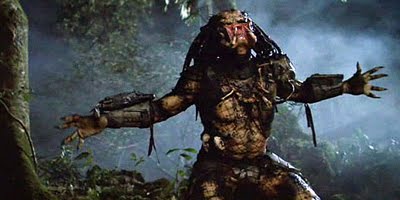
At the Cinema: Predators

Predators (Nimród Antal/2010) USA/106 mins. *****


Welcome to the jungle. Eight lethally well-equipped tough guys (and one gal) get unceremoniously parachuted down on hostile, uncharted territory - a place of strange beasties and various tropical fauna (think Lost but nowhere near as confusing) - and are left to defend themselves against a pack of ungodly creatures unsportingly tracking them down, intent on making mincemeat of all and sundry. We know the hunters are alien Predators ("we never knew what to call them," says one character), but the game this time are Adrien Brody, in mumbling hunk mode, and a gaggle of unwanted earth rejects - whose number include a Yakuza assassin, sheepish doctor, Russian Spetsnaz soldier and numerous rebel military types. With guns. Lots of guns. Apparently alone and unwitting they have to work out why they're there in the first place whilst avoiding being ripped in two.


The structure and tone of Predators has a decidedly retrospective hue - a very 1980s hue to be precise; it nicely harks back in style to Predator '87. The events of Arnie's original are alluded to - but its sequel and the recent Alien vs Predator mash-ups are perhaps tactfully ignored - suggesting the film as a Superman Returns style reboot, not a strict continuation. But instead of adding unnecessarily tricky plot diversions or attempts to tie the whole Predator universe into a tidy bow, Nimród Antal (Kontroll, Vacancy) and producer Robert Rodriguez's overhaul is relatively fuss free and, for the most part, gets down to business, post-haste. Although the initial build up takes its time, and there are a few moments where it feels as if it doesn't quite know where it wants to go, but perhaps the narrative's hesitancy chimes with the characters' meandering trepidation - wouldn't we be cautiously nonplussed plonked down on forested, alien terrain with the inevitability of grisly goings-on around every tree?


The characters are rote and talk as if they've just read a manual on Tough Movie Speak, and personality is lacking, but we all know that we just came to see random hard-bodied nutjobs get picked off one-by-one by the invisible alien menaces in the most inventively gooey way possible. Although Brody caked in mud and Alice Braga, handy with a sniper rifle, are a pleasure to watch. There are a few successful plot curveballs thrown - not exactly major deviations from the template, but surprising nonetheless - and one or two not so successfully thrown around. And the film takes a bit of time out to ponder the question of who just exactly are the real predators here folks. But tish-tosh to rational  reasoning or plausible context. I enjoyed seeing the predators have a good old-fashioned jungle carve-up once again.

6 July 2010

Tuesday Title: Manhattan

Each Tuesday I post a still from the opening titles of a film - as a celebration of great title sequences, cinematic use of typography and the feeling of anticipation in waiting for a film to start...

Today: Manhattan (Woody Allen/1979)


Since roughly 1977 Woody Allen has famously used the same opening title design for each of his films, but one of several of his earlier films to not follow the long-held tradition of using white EF Windsor Elongated or Condensed on black is Manhattan. (The titles for What's Up, Tiger Lily?, Take the Money and Run, Bananas, Everything You Always Wanted to Know About Sex* But Were Afraid to Ask, Sleeper, Love and Death and Interiors appear without Windsor - the rest, to the best of my knowledge, all use the typeface.) We just have the black & white image of the vertical signage accompanied on the soundtrack by his celebrated monologue ("Chapter One. He was as tough and romantic as the city he loved...") and that Gershwin score.

For a film which has always been very much an open love letter to New York, a celebration of its romantic spaces, for him to have used the same opening titles as in every other of his films would've lessened the romance he extols and denied us the pleasure of sharing in his wonder. We wouldn't have seen the city itself as the real central character of the film. It's all in the name. The monologue, music and beautifully chosen and composed shots of Manhattan work together as an introductory, and very arty, slide show, mapping out the places Allen (as Isaac) wants to take us to over the course of the film.

4 July 2010

Here's a Thought: Psycho 1998 didn't kill off Psycho 1960

So, twelve years on and Hitchcock's Psycho didn't disappear when Gus Van Sant made Psycho mark two.


Instead of greeting the remake with outright dismissal as many folk did, I always thought it more interesting to look at it for what it tried to do. I was always under the impression that as much as it was a remake, it was also an experiment. In some folks' eyes it was just an exercise, a retread, a homage, a blasphemous shambles. Any or all of the above. But its formal daring and artificial qualities intrigued me more than they baffled or infuriated me.


Van Sant clearly wanted to do a near-direct retelling of the Psycho story (it's not exactly shot-for-shot) for whatever barmy reasons or creative purposes he had in mind. It may have been his love for the original. Or maybe it was just to shake up people's long-held adoration of a revered classic? Maybe he thought the Bates Motel needed a new coat of paint, a freshen up. Who knows? Either way, the reception to the outcome regretfully outweighed the merits of its intention.


It's not a masterpiece like Hitchcock's original. Of course it's not. Nor is it a particularly incisive or truly surprising film. But it's certainly worthy of discussion and further thought. It was commendable and entertaining for the most part. Vince Vaughan can't match Anthony Perkins' thin-lipped deceitfulness and he doesn't try to. But he does make Norman Bates boyish, icky, embarrassed. Anne Heche doesn't have Janet Leigh's subdued elegance or her nervy poise but she does a game impression of her, early '60s clipped accent and all. (And Van Sant appearing outside Marion Crane's office talking to a Hitch look-a-like, where Hitch himself stood in the original in one of his usual blink-and-miss-it cameos, was a witty touch.)


There are diverting pleasures throughout, both imitative and unforeseen. I was drawn in by sheer fascination alone. And can we truly say, with honesty, that a great many remakes, before or since, have been compelling or fascinating? Even if it's due to being drawn in via the in-built novelty factor. I stayed to see how the infamous shower slaying was to be played out.

I embraced Van Sant's version as a cheeky reply (a rebuttal?) instead of lazily fobbing it off as an insult. Folk, even today, and over a decade on, still find new ways to be appalled by the film: check out any online messaging forum with the words 'Psycho' and 'remake' as a subject line and see how the knee-jerk derision outweighs the thoughtful assessment. I always tow the line that if you love the original then why not be at least partially interested in what someone else could do the the same material? It's only essentially trading like for like anyhow.


After all, Van Sant's version didn't replace Hitchcock's. It's still there. Now we have two Psychos to choose from. What choice? Watch them both. Chronologically, or not. Accompanied by the original's three sequels or without them. I love the intrigue of the story of Psycho. I love Hitchcock for making Psycho, one of the most impacting and resonant films of the last 50 years. And I also like that Gus Van Sant took a creative route in reminding the world about it. It didn't need to be remade. Nothing does. But it accompanies the Hitchcock - it doesn't take its place.


*Now, I'd like to see some bold, fearless director take on Citizen Kane. Paul Verhoeven's version, say? Or maybe Brian De Palma's? Or how about a Farrelly brothers take? Such old, canonised stalwarts of cinema aren't forever untouchable, are they?

*I'm only partially joking. Perhaps.